 Skip to content
How Temporary Pump Systems Support Maintenance and Cleaning Operations
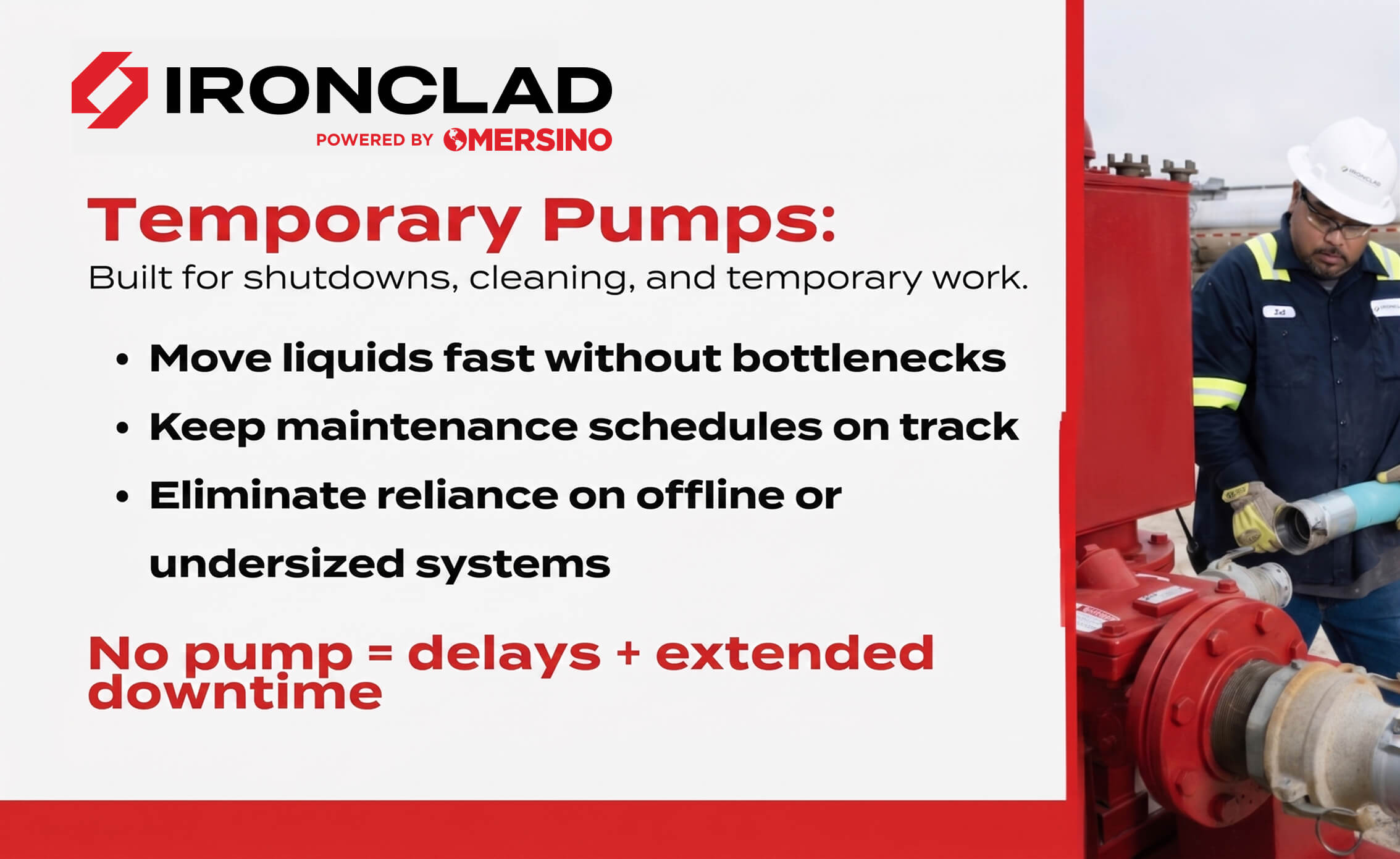
Maintenance shutdowns, tank cleaning, and facility turnarounds all share a common operational need: moving liquid fast, safely, and on a schedule that doesn't have room for delays.
Permanent pump infrastructure isn't always sized or positioned for temporary maintenance work. And when the pumps themselves are the subject of the maintenance, they're not available at all. Relying on fixed systems that weren't designed for the task creates bottlenecks — and bottlenecks on a maintenance window cost real money.
Temporary pump systems fill that gap. The right pump, on-site when needed, configured for the specific job — and demobilized when the work is done.
What Temporary Pump Systems Are (and Aren't)
A temporary pump system isn't a workaround for inadequate permanent infrastructure. It's a purpose-built solution for short-duration or project-based liquid transfer and dewatering needs where deploying a rental is faster, more cost-effective, and operationally cleaner than trying to adapt fixed systems to tasks they weren't designed for.
The core advantage is operational flexibility. Rental pumps are deployed for a specific task at a specific flow rate and configuration, then demobilized when the work is complete. No capital investment. No long-term maintenance obligation. No permanent footprint on the site.
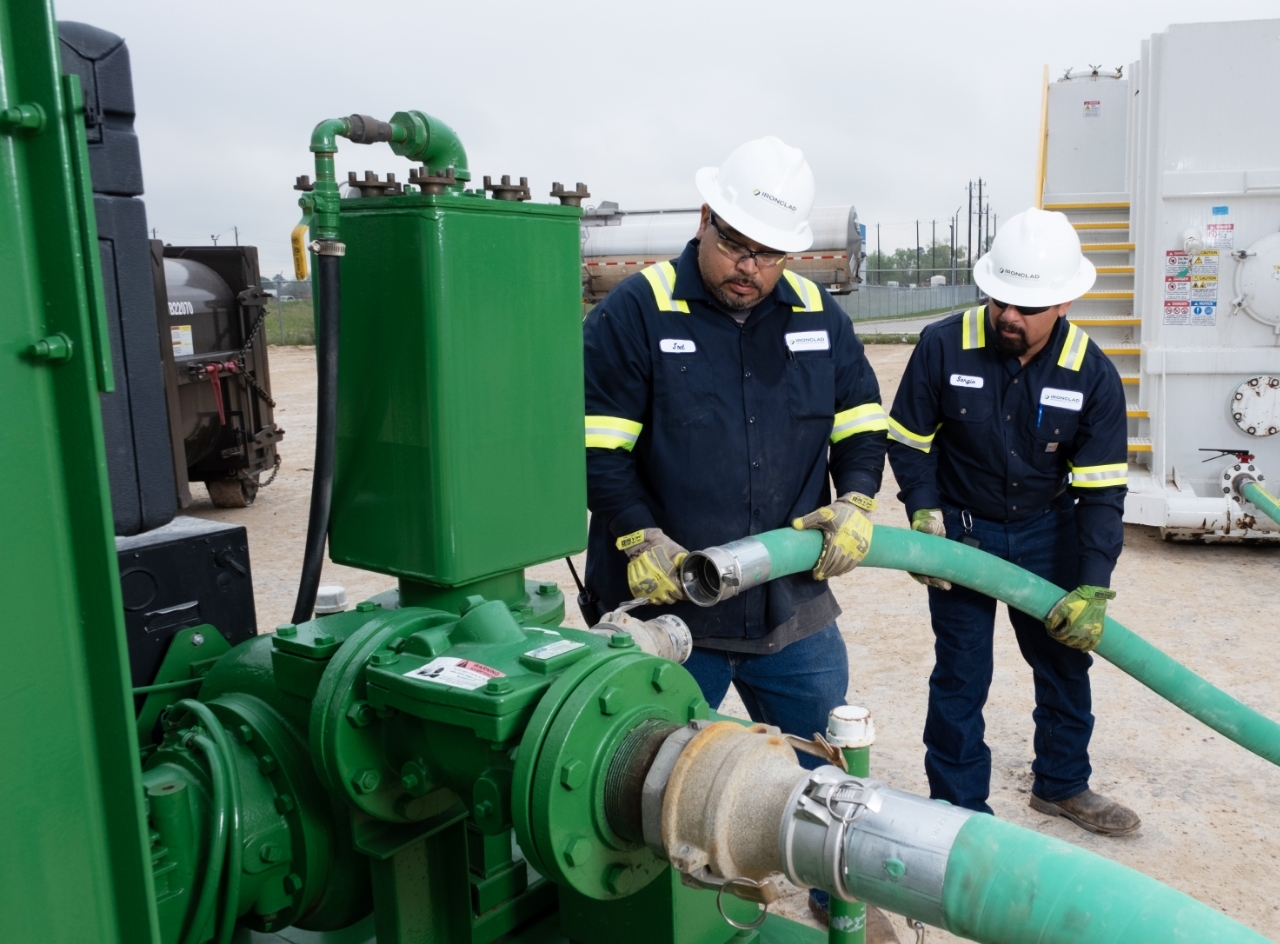
Ironclad's pump rental fleet is designed to meet liquid transfer and dewatering needs across construction, municipal, manufacturing, petroleum refining, and other industrial applications. Pumps are deployed as a standalone solution or alongside the broader containment fleet — the pump moves the liquid, the tank holds it.
Core Applications in Maintenance and Cleaning
Temporary pump systems show up across a wide range of maintenance and cleaning scenarios. Here's how they're applied in practice.
Tank Cleaning and Degassing Preparation
Before a storage tank can be entered for inspection, cleaning, or repair, residual contents need to be pumped down to an acceptable level. Permanent transfer pumps may not be positioned to drain the vessel completely — or the tank's own pump system may be offline as part of the work scope.
A temporary pump deployed alongside a frac tank handles the transfer efficiently. The contents move into temporary storage while the vessel is cleared for entry. Pump selection here depends on fluid viscosity, temperature, and whether the residual material has solids content that requires a trash or solids-handling pump.
Process Line Flushing and Piping Maintenance
Inspection, repair, or replacement of process piping requires the lines to be cleared of fluid first. Temporary pump systems move flush water and process residuals into holding tanks without disrupting adjacent systems that remain in service.
Flow rate and head pressure are the primary sizing factors for this application. Lines that run at elevation or over long distances require pumps with higher head capacity than those handling short, low-elevation transfers. Getting this wrong means the pump runs continuously but moves less fluid than the job requires — extending the maintenance window and the associated downtime.
Facility Dewatering During Planned Shutdown
Water accumulates in pits, sumps, basements, and low-lying areas during both planned shutdowns and unplanned outages. When permanent sump pump systems are offline for maintenance or when inflow exceeds their capacity, temporary submersible and centrifugal pumps extract standing water and transfer it to containment or approved discharge.
On construction sites, this is the standard dewatering scenario: groundwater and surface water inflow during active excavation requires continuous pumping to maintain dry working conditions. Pumps are paired with frac tanks or dewatering boxes to hold the extracted water before treatment or discharge.
Cooling Tower and Heat Exchanger Maintenance
Draining and flushing cooling systems requires temporary pumping capacity that typically exceeds what permanent infrastructure can support during a maintenance window. Cooling tower basins hold significant volumes, and heat exchanger flushing generates additional liquid that needs to be captured and managed before it can be discharged or treated.
Temporary pump systems sized to the drain-down volume and time window keep the maintenance schedule on track. Pairing with closed top frac tanks is standard when the cooling water chemistry includes treatment chemicals that require containment before disposal.
Municipal and Utility Maintenance Operations
Water main repairs, lift station maintenance, and sewer bypass operations all require temporary pumping to keep service running while permanent infrastructure is offline. Bypass pumping systems maintain flow around the work area, preventing service interruption and sewer overflows during the maintenance window.

Matching the Right Pump to the Job
Pump selection isn't one-size-fits-all. The right pump for a cooling tower drain-down is different from the right pump for a sump dewatering operation or a process line flush. Key factors that drive the decision:
- Flow rate: How much liquid needs to move, and how fast? Flow rate requirements determine pump sizing. Undersized pumps extend the job. Oversized pumps waste fuel and can create velocity issues in downstream tanks or discharge lines.
- Head pressure: How high and how far does the liquid need to travel? Elevation change and discharge distance both contribute to total dynamic head. A pump that performs well at ground level may not move adequate volume when pumping uphill or over a long run.
- Fluid type: Clean water, sediment-laden water, and process fluid with suspended solids each require different pump configurations. Trash pumps handle debris and solids. Submersible pumps work in sumps and pits. Centrifugal pumps handle high-volume clean or lightly contaminated liquid transfer.
- Power source: Electric-driven pumps are efficient where power is available. Diesel-driven pumps are the right call for remote sites, unpowered locations, or anywhere grid power isn't reliable during the maintenance window.
- Pump-to-tank pairing: Pump capacity needs to match tank fill rate and transfer requirements. A high-volume pump filling a single 500 BBL frac tank will hit capacity faster than anticipated if the transfer rate exceeds the tank's usable volume per hour. Multi-tank manifold setups are often the right answer when pump throughput is high.

How Pump Rentals Pair With Temporary Storage
The pump and the tank are one system. Moving liquid without somewhere to put it creates a compliance problem, not a solution — and a tank without adequate pump capacity to fill or drain it on schedule creates an operational one.
Common pairings in maintenance and cleaning operations:
- Centrifugal pump + closed top frac tank for process fluid transfer during tank cleaning or line flushing where vapor control is required.
- Submersible pump + open top frac tank for pit and sump dewatering during facility shutdowns and construction excavation.
- High-volume pump + manifolded frac tanks for large-scale cooling system drain-downs or refinery maintenance where total liquid volume exceeds a single tank's capacity.
Ironclad provides both pumps and containment — deployed as a coordinated solution. Pump capacity and tank volume are matched before equipment arrives on-site, not adjusted after the fact.
Ironclad's Pump Rental Fleet
Ironclad Environmental Solutions offers reliable water pump rentals designed to meet liquid transfer and dewatering needs across a wide range of applications — construction, municipal, manufacturing, petroleum refining, and more.
Our pump fleet is built for efficiency and performance across varying flow rates, fluid types, and site conditions. Whether the job is a planned maintenance shutdown, an emergency dewatering operation, or a long-duration construction project, the right pump configuration is available and deployable fast.
Because Ironclad provides both pump systems and the full range of containment equipment — frac tanks, roll-off boxes, vacuum boxes, double wall tanks, and more — pump and tank deployment is coordinated as a single solution. One call, one provider, one system that's matched and ready to work.
Need pump and containment support for an upcoming maintenance window or active dewatering operation?
Contact Ironclad Environmental Solutions to discuss your flow requirements, fluid type, and site conditions. We'll match the right pump and storage configuration to your job.