 Skip to content
Hydrotesting Water Management: What Industrial Sites Need for Storage and Disposal
Hydrotesting is a pressure test that uses water to verify the structural integrity of pipelines, storage tanks, and pressure vessels before they go into service. It's a standard requirement across oil and gas, chemical manufacturing, power generation, and municipal infrastructure—but the test itself is only part of the job.
The real challenge is managing the water. A single pipeline hydrotest can generate hundreds of thousands of gallons that need to be stored, tested for contamination, and disposed of in compliance with federal and state regulations. Without proper planning, water management becomes the bottleneck that delays commissioning, triggers compliance issues, and drives up project costs.
This guide covers what industrial sites need to manage hydrotest water from start to finish—including storage equipment, treatment requirements, disposal options, and the regulations that govern the process.

What Is Hydrotesting?
Hydrotesting—also called hydrostatic testing—is a method for verifying that pipelines, pressure vessels, and storage tanks can safely operate at their intended pressure levels. The process involves filling the equipment with water, pressurizing it beyond normal operating conditions, and holding that pressure while monitoring for leaks, deformation, or structural failure.
Water is the preferred test medium because it's incompressible. If a pipe or vessel fails during a hydrotest, water doesn't expand violently the way compressed air or gas would—making water-based testing significantly safer.
Hydrotesting is required at several points in an asset's lifecycle:
- New construction – Verifying welds, joints, and materials meet specifications before commissioning
- Post-repair – Confirming repairs restored structural integrity
- Regulatory compliance – Meeting periodic inspection requirements under ASME, API, and DOT standards
- Ownership transfer – Documenting asset condition during sales or acquisitions
The test itself is straightforward. The complication is what happens to the water afterward.

Why Hydrotesting Water Management Matters
Three factors make hydrotest water management a critical part of project planning:
Volume
Hydrotesting requires filling the entire internal volume of the pipeline or vessel being tested—plus additional water for pressurization. A 20-inch diameter pipeline running 10 miles holds approximately 2.6 million gallons. Even smaller projects routinely involve tens of thousands of gallons that must be stored on site before, during, and after the test.
Without adequate storage capacity, projects stall mid-test waiting for tanks or transport equipment.
Contamination
Test water rarely comes out clean. As it moves through pipelines and vessels, it picks up residues from manufacturing, construction, and previous operations:
- Mill scale and rust from new steel pipe
- Cutting oils and lubricants from fabrication
- Residual product from lines that previously carried crude oil, refined fuels, or chemicals
- Chemical inhibitors added to prevent corrosion during testing
- Sediment and debris from construction
Contaminated water can't simply be discharged. It requires testing, treatment, and documented disposal through approved channels.
Regulations
The Clean Water Act prohibits discharging pollutants into waters of the United States without a permit. For hydrotest water, this means:
- Surface water discharge requires an NPDES (National Pollutant Discharge Elimination System) permit from EPA or an authorized state agency
- Municipal sewer discharge requires approval from the local publicly owned treatment works (POTW), which may impose pretreatment requirements
- Land application may require state permits depending on water quality and volume
Violations carry civil penalties up to $64,618 per day under current EPA enforcement guidelines. Beyond fines, unpermitted discharge can halt a project entirely while regulators investigate.
The Hydrotesting Water Management Process
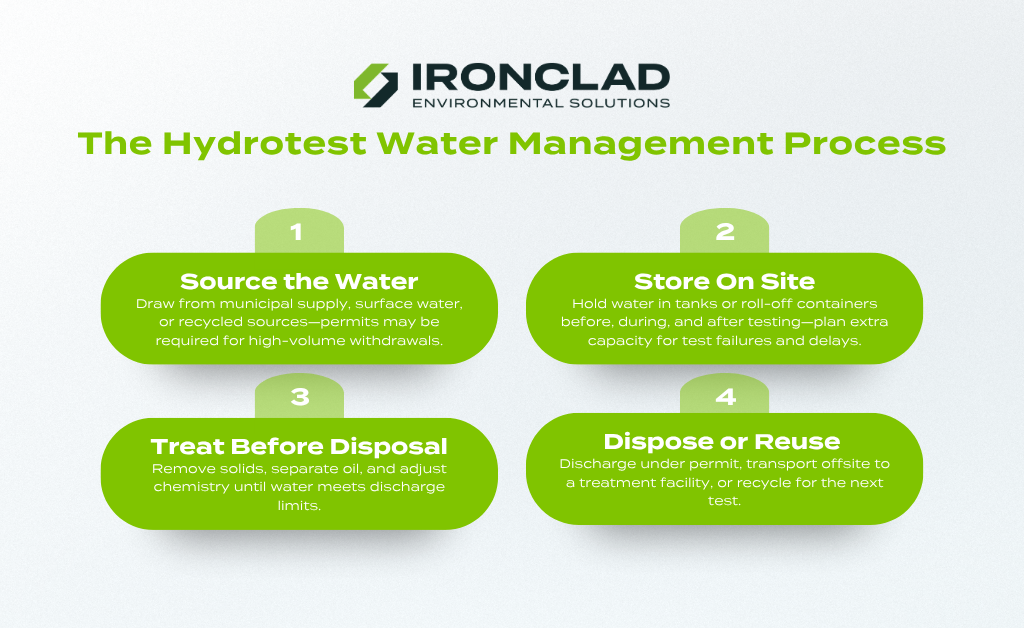
Managing hydrotest water involves four stages: sourcing, storage, treatment, and disposal. Each stage requires planning and, in many cases, permits or regulatory approval.
1. Water Sourcing
Hydrotest water typically comes from one of three sources:
- Municipal supply – Reliable quality, but high-volume draws may require coordination with the utility and incur significant cost
- Surface water – Rivers, lakes, or ponds near the job site; permits are often required for withdrawal, and screening may be necessary to protect aquatic life
- Recycled water – Treated water from previous hydrotests; reduces sourcing costs and disposal volume when water quality permits reuse
Sourcing decisions depend on volume requirements, water availability, and local permitting timelines. On remote pipeline projects, surface water may be the only practical option—but permit lead times can stretch weeks or months.
2. Storage During Testing
Hydrotest water needs a place to go at every stage of the process:
- Before testing – Holding water drawn from the source until the line or vessel is ready to fill
- During testing – Capturing water displaced as the system is pressurized, plus contingency storage if a test fails and must be repeated
- After testing – Holding water for sampling, treatment, and disposal
Storage requirements often exceed the volume of the pipeline or vessel being tested. A failed test means draining, repairing, and refilling—doubling or tripling water handling needs. Weather delays can extend hold times, tying up storage capacity longer than planned.
On-site storage typically involves above-ground tanks (steel or poly), frac tanks, or large-volume roll-off containers positioned near the test site.
3. Water Treatment
Before disposal, hydrotest water must meet discharge standards set by the receiving permit or facility. Treatment requirements depend on what contaminants are present:
- Oil and grease – Separated using weirs, skimmers, or oil-water separators
- Suspended solids – Removed through settling, filtration, or dewatering
- Chemical additives – May require neutralization or dilution
- pH adjustment – Necessary if corrosion inhibitors or cleaning agents altered water chemistry
Water must be sampled and tested to verify it meets discharge limits. Common parameters include pH, total suspended solids (TSS), oil and grease, chemical oxygen demand (COD), and specific contaminants based on what the line previously carried.
4. Disposal or Reuse
Once water meets applicable standards, disposal options include:
- Permitted surface discharge – Releasing water to a river, stream, or other water body under an NPDES permit
- Municipal sewer – Discharging to a POTW with prior approval and any required pretreatment
- Offsite treatment – Transporting water by vacuum truck or tanker trailer to a licensed disposal facility
- Recycling – Treating and reusing water for subsequent hydrotests on the same project
Recycling is increasingly common on large pipeline projects where multiple sections require testing. Filtering and treating water for reuse reduces both sourcing costs and disposal volume—but requires storage capacity and treatment equipment to maintain water quality between tests.
Equipment Needed for Hydrotesting Water Management
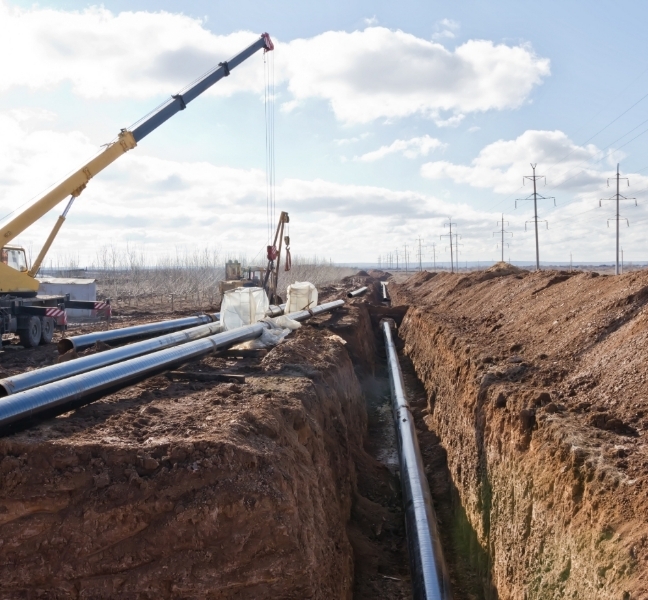
Hydrotest water management requires equipment for storage, transport, and—depending on site requirements—containment. The specific mix depends on project volume, site conditions, and disposal pathway.
Storage Tanks
Above-ground storage tanks hold water at every stage of the hydrotest process. Options include:
- Steel tanks – Durable, high-capacity storage for large-volume projects; suitable for water with chemical additives or elevated temperatures
- Poly tanks – Corrosion-resistant option for water containing acids, caustics, or other aggressive chemicals; lighter weight simplifies mobilization
- Double-wall tanks – Provide built-in secondary containment for sites with strict spill prevention requirements
- IronMax tanks – Large-capacity above-ground tanks designed for temporary deployment; common on pipeline and oilfield projects
Tank selection depends on water chemistry, required volume, and how long water will be held on site.
Roll-Off Boxes
Roll-off containers handle collection, treatment, and transport functions that tanks alone can't address:
- Vacuum boxes – Collect water from low points, sumps, and hard-to-reach areas; transport water offsite for disposal
- Dewatering boxes – Filter suspended solids from water before discharge; essential when sediment loads exceed permit limits
- Metal lid boxes – Secure storage for water awaiting testing or transport; prevent rainwater intrusion that would increase disposal volume
Roll-off equipment mobilizes quickly and works in tight spaces where large tanks won't fit.
Tanker Trailers
Stainless steel tanker trailers transport water to and from the job site—hauling source water in and contaminated water out. Tankers are essential when:
- Surface water sources are distant from the test site
- Water must be transported to an offsite treatment or disposal facility
- Recycled water needs to move between test sections on a pipeline project
Pumps and Accessories
Transfer pumps, hoses, manifolds, and fittings connect the system—moving water between sources, tanks, the test section, and disposal points. Pump sizing depends on required flow rates and the distances involved.
Regulatory Considerations for Hydrotest Water Disposal
Hydrotest water disposal is governed by federal, state, and local regulations. Requirements depend on water quality, disposal method, and location—but the baseline is straightforward: you need permission before discharge and documentation to prove compliance.
Federal Requirements
The Clean Water Act establishes the framework:
- NPDES permits – Required for any discharge to surface waters. Permits specify allowable contaminant levels, discharge rates, and monitoring requirements. General permits cover routine discharges in many states; complex projects may require individual permits with longer lead times.
- SPCC plans – Apply when hydrotesting equipment that previously held oil or petroleum products. Plans must address containment, response procedures, and reporting.
- RCRA considerations – If hydrotest water contains hazardous constituents above threshold levels, it may require disposal at permitted hazardous waste facilities.
State and Local Requirements
State agencies often administer NPDES permits with restrictions beyond federal minimums. Some states impose stricter limits on specific contaminants. Municipal POTWs set pretreatment standards for sewer discharge. Water withdrawal permits may be required for surface water sourcing above certain thresholds.
Requirements vary significantly by jurisdiction. A disposal method that's routine in one state may require extensive permitting in another. Check early—permit timelines range from days to months.
Industry Standards
ASME, API, and DOT standards govern hydrotesting procedures and documentation. These don't directly regulate water disposal, but they establish documentation requirements that often include water handling records.
Common Hydrotesting Water Management Challenges
Underestimating Volume
Projects stall when tanks fill up mid-test with nowhere to put displaced water. Plan for 1.5 to 2 times the calculated test volume to cover failures, extended holds, and weather delays.
Contamination Surprises
A "clean" new pipeline may have more mill scale than expected. A line that was supposedly purged still contains residual product. Sample early and have backup treatment capacity available.
Permitting Delays
Starting the permitting process after mobilization causes delays. Identify the disposal pathway and initiate applications during project planning—not after water is on site.
Equipment Availability
Tanks and transport equipment are in high demand during peak seasons. Last-minute sourcing means premium pricing. Reserve equipment early.
Weather and Site Constraints
Rain adds volume to open storage. Freezing temperatures complicate operations. Tight sites limit equipment options. Monitor forecasts and survey site access early.
Planning for a Successful Hydrotest
- Estimate total water volume – Calculate internal volume plus pressurization, then add contingency. Plan for 1.5 to 2 times the base calculation.
- Secure storage equipment early – Reserve tanks, roll-off boxes, and transport equipment before mobilization.
- Identify the disposal pathway – Surface water, municipal sewer, or offsite transport. Understand permit requirements.
- Initiate permits during planning – NPDES permits, POTW approvals, and withdrawal permits all have lead times.
- Arrange water quality testing – Identify a lab and factor turnaround time into the schedule.
- Plan for treatment – Have filtration, separation, or chemical treatment capacity available based on expected water quality.
- Establish contingency plans – Know what happens if the test fails or water quality doesn't meet limits.
Key Takeaways
- Hydrotesting verifies structural integrity—but managing the water is often more complex than the test itself
- A single hydrotest can generate hundreds of thousands of gallons requiring storage, treatment, and proper disposal
- The Clean Water Act requires permits for surface discharge; municipal disposal requires POTW approval
- Storage tanks, vacuum boxes, dewatering boxes, and tanker trailers are essential equipment
- Planning ahead prevents the delays and cost overruns that derail projects
Frequently Asked Questions
What is hydrotesting? A pressure test using water to verify the structural integrity of pipelines, tanks, and pressure vessels. Equipment is filled, pressurized above operating levels, and monitored for leaks. Required for new construction, repairs, and regulatory compliance.
Why can't hydrotest water just be discharged? Test water picks up contaminants—mill scale, rust, oil, chemical inhibitors. The Clean Water Act prohibits discharging pollutants without a permit. Water may require treatment or transport to a licensed disposal facility.
What equipment is needed? Storage tanks (steel, poly, or double-wall), vacuum boxes, dewatering boxes, tanker trailers, and transfer pumps. The mix depends on volume, water quality, and site conditions.
What permits are required? Surface water discharge requires an NPDES permit. Municipal sewer discharge requires POTW approval. Water sourcing may require withdrawal permits. Requirements vary by location.
How do I estimate water volume? Calculate internal volume of the pipeline or vessel, add pressurization volume, then plan for 1.5 to 2 times that total to cover contingencies.
Can hydrotest water be reused? Yes, when water quality permits. Filtering and treating between tests reduces sourcing and disposal costs but requires storage and treatment capacity.
Keep Your Hydrotest on Schedule
Hydrotesting is straightforward—fill, pressurize, hold, monitor. Managing the water is where projects get complicated.
Estimate volume conservatively, secure equipment early, start permits during planning, and have contingency plans ready. That's how projects stay on schedule.
Ironclad Environmental Solutions provides rent-ready storage tanks, vacuum boxes, dewatering boxes, and tanker trailers for hydrotesting projects. 24/7 availability. Local support. Tough, tested equipment when and where you need it.