 Skip to content
Frac Tank Capacity Guide: Sizes, Gallons, and What You Need to Know
A standard frac tank holds 21,000 gallons (500 BBL). But "standard" doesn't always mean "right for the job."
Frac tank capacity needs vary based on what you're storing, how much volume you're dealing with, how long the project runs, and what your site can physically accommodate. Undersizing means operational delays and potential compliance issues. Oversizing wastes budget and takes up space you may not have.
This guide breaks down frac tank sizes, capacities, and configurations available through Ironclad Environmental Solutions, along with the factors that determine which tank is the right fit for your project.
For Detailed Frac Tank Specs: https://ironcladenvironmental.com/tech-sheets/
Standard Frac Tank Sizes and Capacities
Most frac tanks fall into the 500 BBL (21,000 gallon) range, but there's more variation across configurations than many operators realize. Tank design, bottom profile, wall construction, and material all affect dimensions, weight, and suitability for specific applications.
Here's how Ironclad's frac tank lineup breaks down:
500 BBL (21,000 Gallon) Configurations
| Tank Type | Capacity | Dimensions (L x W x H) | Tare Weight | Key Feature |
| Open Top Steel | 21,000 gal (500 BBL) | 51'6" x 8' x 13'1" | ~28,000 lbs | Full top access for pumping, treatment, or monitoring |
| Closed Top V-Bottom | 21,000 gal (500 BBL) | 42' x 8'6" x 9'8" | — | V-bottom for complete drain-out; vapor containment |
| Closed Top Round Bottom | 21,000 gal (500 BBL) | ~47' x 8'6" x 11'1" | — | Round bottom profile; closed top for vapor control |
| Insulated Closed Top | 21,000 gal (500 BBL) | 45'9" x 8'6" x 11'1" | 29,900 lbs | EPS insulation (R-16); field-convertible insulated/non-insulated |
| Stainless Steel | 21,000 gal (500 BBL) | 45'8" x 8'6" x 10'7" | 26,000 lbs | 304 SS construction for chemical compatibility |
| Steel w/ Steam Coils | 21,000 gal (500 BBL) | 46'4" x 8'6" x 10'4" | 27,000 lbs | Integrated steam coils for temperature-sensitive liquids |
Mid-Range and Compact Configurations
| Tank Type | Capacity | Dimensions (L x W x H) | Tare Weight | Key Feature |
| 438 BBL Double Wall | 18,430 gal | 45'8" x 8'6" x 8'11" | 36,000 lbs | Built-in secondary containment; interstitial monitoring |
| 430 BBL Open Top | 18,060 gal | 46'1" x 8' x 13' | 26,820 lbs | Slightly smaller footprint; available in California |
| 427 BBL Weir Tank | 17,934 gal | 42' x 8'6" x 9'8" | 15,000 lbs | Internal weirs for settling and decanting |
| 170 BBL Double Wall Mini | 7,200 gal | 23'2" x 8'6" x 8'8" | 18,000 lbs | Compact double-wall for tight spaces with built-in containment |
170 BBL Double Wall Mini7,200 gal23'2" x 8'6" x 8'8"18,000 lbsCompact double-wall for tight spaces with built-in containment
Key Differences Between Configurations
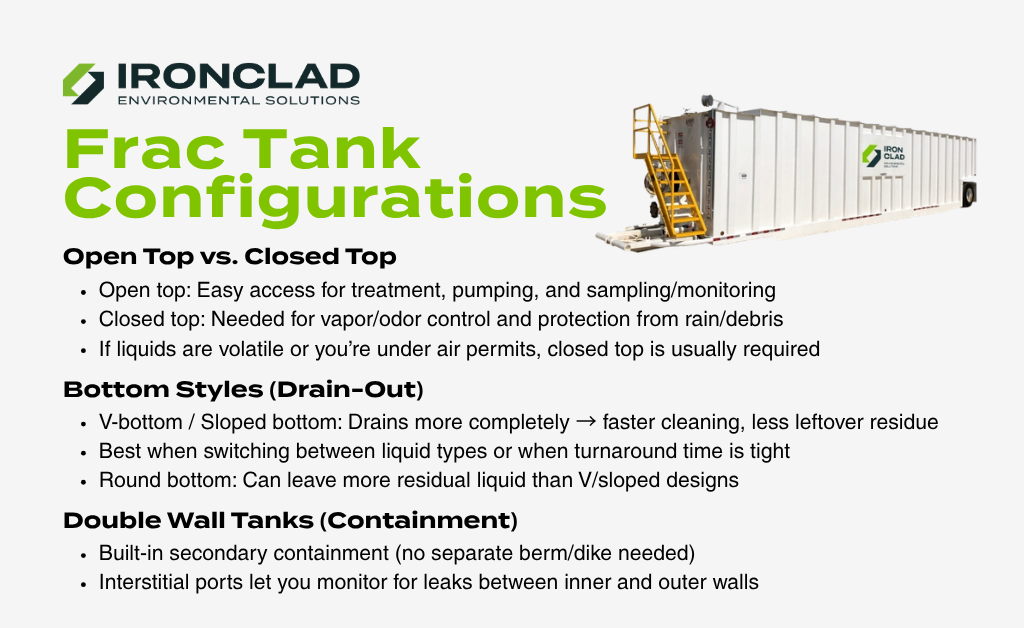
Open top vs. closed top matters more than some operators think. Open top tanks give you direct access to stored liquids for treatment, pumping, or monitoring. Closed top tanks are required when you need vapor containment, odor control, or protection from weather and debris. If you're handling volatile organics or working under air quality permits, closed top is typically non-negotiable.
V-bottom vs. round bottom vs. sloped bottom affects drain-out. V-bottom and sloped bottom designs allow for more complete drainage, which reduces cleaning time between uses and prevents residual contamination. This matters most when tanks are being rotated between different liquid types or when turnaround time is tight.
Double wall tanks provide integrated secondary containment. Instead of placing a single-wall tank inside a separate containment berm or dike, a double wall unit handles both primary and secondary containment in one asset. Interstitial drain ports allow monitoring for leaks between the inner and outer walls.
Beyond Standard Frac Tanks: Specialty and High-Capacity Options
Not every liquid storage need fits a standard frac tank configuration. Ironclad's fleet includes several specialty tank types that serve specific operational requirements.
Mix Tanks — Built for applications requiring agitation or circulation of stored liquids.
- 420 BBL (17,630 gal): Four individually controlled 10 hp explosion-proof motors with integrated heating coils
- 168 BBL mini (7,070 gal): Two independently controlled agitators in a compact 23'8" footprint
Weir Tanks — Internal baffles promote settling and separation of oils and suspended solids.
- 173 BBL mini weir (7,266 gal): Gravity separation and turbidity reduction at 24' x 8'6", built for tight job sites
Vertical Tanks — Solve the most common site constraint: footprint.
- 350 BBL (14,700 gal): Stands 27' tall with only a 72" diameter. Skid-mounted with fork pockets, meets Cal/OSHA guidelines, and doesn't require an oversized load permit for transport.
Poly Tanks — Handle what steel can't.
- 5,050-gallon upright poly: High-density cross-linked polyethylene for chemicals, caustics, and acidic materials
- 6,300-gallon (150 BBL) poly cube: Roll-off understructure with fume-tight lid for easy transport and positioning
IronMax Tanks — For capacity well beyond standard frac tanks. These modular, bolt-together above-ground systems use ASTM A36 steel panels with a full interior geomembrane liner. Four standard sizes available:
- 18,000 BBL (756,000 gallons)
- 27,000 BBL (1 million gallons)
- 40,000 BBL (1.7 million gallons)
- 60,000 BBL (2.5 million gallons)
IronMax is used in pipeline hydrotesting, upstream and midstream operations, and any industrial application requiring massive temporary liquid storage.

What Determines How Much Frac Tank Capacity You Need?
Selecting the right frac tank capacity isn't just about matching gallons to volume. Several operational and site-specific factors drive the decision:
- Liquid type and handling requirements. Water, wastewater, hydrocarbons, and chemicals each come with different containment standards. Corrosive or reactive liquids may require stainless steel or poly construction. Volatile materials need closed-top configurations with vapor control.
- Volume and flow rates. How much liquid are you generating, receiving, or storing at peak? If inflow exceeds your storage capacity even temporarily, you risk overflow, uncontrolled discharge, or operational shutdown. Always size for peak conditions, not average.
- Duration of operation. A 48-hour emergency response has different capacity needs than a 6-month turnaround project. Longer projects may justify larger or multiple tanks. Shorter deployments may favor rapid-mobilization assets already positioned nearby.
- Site footprint and access. A 51-foot open top frac tank requires significant staging area plus room for delivery, hookup, and vac truck access. If your site can't accommodate that, a mini frac tank, vertical tank, or manifolded smaller units may be the better path.
- Regulatory and secondary containment requirements. Many permits and SPCC plans mandate secondary containment equal to or exceeding 100% of the primary vessel's volume. Double wall tanks address this in a single unit. Single wall tanks require external containment (berms, dikes, or lined areas), which adds to footprint and setup time.
- Single tank vs. multi-tank configuration. Sometimes one large tank is the right call. Other times, manifolding two or more tanks together gives you more flexibility, redundancy, and the ability to stage in tight or irregular spaces.
Frac Tank Capacity by Application
How frac tank capacity gets used depends heavily on the application. Here's how tank selection typically maps to common industrial scenarios.
Drilling and completions. Standard 500 BBL frac tanks are the workhorse, used for produced water, flowback, and freshwater storage. Multi-tank manifold setups are common to handle peak flowback volumes. For large-scale hydrotesting, IronMax tanks provide the capacity needed without covering a site in individual tanks.
Refinery turnarounds and chemical plant maintenance. Closed-top tanks are standard for vapor control. Stainless steel tanks handle corrosive or reactive process fluids. Double wall tanks simplify compliance where secondary containment is required. Mix tanks support blending or treatment operations on-site.
Stormwater surge and emergency containment. When permanent infrastructure hits capacity, temporary frac tanks capture overflow and prevent uncontrolled discharge. Open top tanks work for non-volatile stormwater. Weir tanks allow on-site settling before discharge or transport.
Construction dewatering. Excavation dewatering generates high volumes of sediment-laden water. Frac tanks provide temporary holding while solids settle out or water is pumped to treatment. Weir tanks and dewatering boxes handle solids separation on-site.
Spill response. Speed matters. Having pre-established access to frac tanks through a mobilization partnership means equipment arrives in hours instead of days. The 170 BBL mini frac tank is often the first asset deployed to tight-access spill sites, with larger tanks staged behind for bulk storage once the initial response is contained.
Scaling Capacity: Manifolding and Multi-Tank Configurations
When a single tank doesn't provide enough capacity, or when site conditions make one large tank impractical, manifolding multiple tanks together is the standard solution.
Manifolding connects two or more tanks through shared piping so they function as a single storage system. This approach is common on drilling locations, turnaround projects, and large-scale dewatering operations where total volume requirements exceed what one 500 BBL tank can handle.
When planning a multi-tank setup, keep these factors in mind:
- Staging footprint. Each 500 BBL tank is roughly 42-51 feet long depending on configuration. Two manifolded tanks need that length twice, plus working space between units for hose connections, valve access, and personnel movement. Account for vac truck access lanes if tanks will be loaded or offloaded by truck.
- Pump and conveyance connections. Make sure your pump capacity matches the combined volume. If you're filling or draining multiple tanks simultaneously, your transfer equipment needs to handle the aggregate flow rate.
- Peak vs. sustained volume. Size your manifold for peak conditions. If your operation generates 15,000 gallons per day on average but can spike to 40,000 gallons during weather events or process upsets, your storage needs to cover the spike, not the average.
- Mixed configurations. You're not limited to identical tanks. A common setup pairs a standard frac tank for bulk storage with a weir tank downstream for settling and separation. Or a mix tank upstream for treatment followed by a clean-water holding tank before discharge.
How to Choose the Right Frac Tank for Your Project
Quick decision framework when evaluating frac tank options:
- Define your volume requirement. What's the maximum volume you need to contain at any one time? Include a margin for peak conditions.
- Identify the liquid type. Water, wastewater, hydrocarbons, chemicals, or mixed streams? This determines construction material (carbon steel, stainless steel, or poly) and whether you need closed-top vapor control.
- Assess your site. Measure available staging area, confirm ground conditions and load-bearing capacity, verify access routes for delivery trucks, and identify where hookups and discharge points will connect.
- Check your compliance requirements. Do you need secondary containment? Vapor control? Specific permit conditions that dictate tank configuration? Insulation for temperature maintenance?
- Determine the duration. Short-term emergency response, multi-week project support, or long-term operational capacity? Duration affects whether you need rapid-deployment assets or can plan a more complex staged setup.
- Decide: single or multi-tank. If one tank handles it, keep it simple. If not, plan your manifold configuration, staging layout, and pump connections before equipment arrives.
Ironclad's Frac Tank Fleet
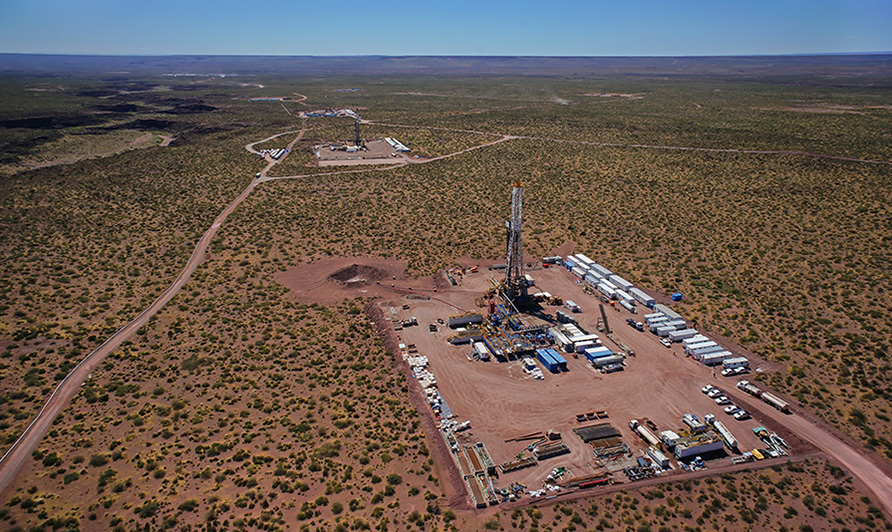
Ironclad Environmental Solutions operates the largest specialty containment fleet in the U.S., with coast-to-coast availability and the ability to mobilize fast.
Our frac tank inventory spans the full range covered in this guide — from 170 BBL mini frac tanks to 60,000 BBL IronMax systems. Every configuration discussed here is available for rental with rapid deployment:
- Open top, closed top, V-bottom, round bottom, and insulated
- Stainless steel and poly for chemical compatibility
- Double wall for built-in secondary containment
- Weir, mix, and vertical tanks for specialized applications
- IronMax modular systems for large-scale storage
Our team helps you select the right asset for your specific situation — not just what's in stock, but what actually solves the problem. That includes evaluating your volume requirements, site constraints, liquid characteristics, and compliance needs before a single tank rolls.
For full specifications on any tank in our fleet, visit our tech sheets page.
Need help sizing frac tank capacity for your next project? Contact Ironclad Environmental Solutions to discuss your requirements and get a quote.
Frac Tank Capacity FAQs
How many gallons does a frac tank hold? A standard frac tank holds 21,000 gallons (500 BBL). Smaller configurations are available starting at 7,200 gallons (170 BBL), and Ironclad's IronMax modular tanks scale up to 2.5 million gallons (60,000 BBL) for large-scale storage needs.
What is the standard frac tank size? The industry standard is 500 BBL, which equals approximately 21,000 gallons. These tanks are typically 42-51 feet long, 8-8.5 feet wide, and 9-13 feet tall depending on the configuration (open top, closed top, V-bottom, or round bottom).
What's the difference between an open top and closed top frac tank? Open top frac tanks allow direct access to stored liquids from above, making them ideal for treatment, pumping, or monitoring operations. Closed top tanks contain vapors and protect contents from weather and debris. Closed top configurations are required when storing volatile materials or working under air quality permits.
Can you connect multiple frac tanks together? Yes. Manifolding connects two or more frac tanks through shared piping so they operate as a single storage system. This is standard practice when total volume requirements exceed the capacity of a single tank, or when site constraints make one large tank impractical.
What's the difference between a frac tank and a weir tank? A frac tank is a general-purpose liquid storage vessel. A weir tank includes internal baffles (weirs) that promote gravity separation of suspended solids and oils from the liquid stream. Weir tanks are used when you need primary settling or turbidity reduction before discharge, filtration, or transport.
How do I know what size frac tank I need? Start with your peak volume requirement, then factor in liquid type, site footprint, access constraints, regulatory requirements, and project duration. A containment provider like Ironclad can assess your specific operation and recommend the right configuration.
What is the largest frac tank available? Ironclad's largest portable frac tank option is the IronMax, a modular above-ground storage system available in configurations up to 60,000 BBL (2.5 million gallons). For standard trailer-mounted frac tanks, the largest common size is 500 BBL (21,000 gallons).