 Skip to content
How Specialty Waste Containment Supports Refinery Turnarounds
A refinery turnaround is one of the highest-stakes maintenance events in the downstream energy sector.
Every hour of schedule slip on a turnaround project translates directly to financial loss. A single unplanned day of outage at a major petroleum refinery can ripple through regional fuel supply — affecting gasoline, diesel, and jet fuel availability and driving a measurable price increase at the pump.
Permanent refinery infrastructure is sized for steady-state production, not for the concentrated waste streams that surface the moment crude oil units come down and vessels are opened up.
That's where specialty waste containment comes in. The right tanks, roll-offs, and supporting equipment, staged on-site before the first valve closes, determine whether a successful turnaround stays on schedule or bleeds into overtime.
What a Refinery Turnaround Is (and Isn't)
A refinery turnaround is a planned, full or partial refinery shutdown of one or more process units for internal inspection, equipment replacement, catalyst change-out, vessel entry, and extensive maintenance that can't be performed while crude oil is flowing.
Typical turnaround intervals run three to five years per individual unit. Major units like FCCs, crude towers, and hydrotreaters drive the longest and most complex turnaround events.
The distinction matters because turnaround planning compresses months of work into a tightly choreographed window. Hundreds of skilled labor work hours from contractors land on-site simultaneously. Every shift is pre-sequenced. OSHA's Process Safety Management standard layers specific safety requirements on top of the refinery's own maintenance programs.
Containment capacity, tank placement, and secondary containment have to be locked in during the planning phase — not scrambled for in execution.
High-performing plants treat containment as a scheduled deliverable with the same rigor as scaffolding or crane picks:
- Under-provisioning causes schedule-critical delays when crews are stood up and waiting on tankage
- Over-provisioning ties up congested real estate that the turnaround contractor needs for laydown

Core Containment and Environmental Needs During a Turnaround
A single process unit turnaround can generate hundreds of thousands of gallons of wash water, hydroblast returns, slop oil, and rinse water, all of which need temporary containment before disposal or reprocessing.
The core waste streams a specialty containment partner has to handle include:
- Vessel and tower drain-down. Process units need to be de-inventoried before they can be opened. Frac tanks capture residual hydrocarbons, water, and interface fluids pulled from columns, drums, and reactor beds.
- Hydroblast and wash-water management. High-pressure cleaning of exchanger bundles, fired heater tubes, and internals generates large volumes of oily, solids-laden water. Weir tanks and roll-off boxes capture returns, let solids settle, and stage water for disposal.
- Heat exchanger and cooler cleaning. Bundle pulls require temporary containment under and around the work area to capture drain-down fluids and prevent uncontrolled release into a unit drain system that may already be at capacity.
- Catalyst and spent material handling. Catalyst unloading from reactors and hydrotreaters requires segregated containment to manage pyrophoric and spent material until it's shipped for reclamation.
- Slop oil and interface recovery. Mixed hydrocarbon-water streams pulled from unit sumps need dedicated tankage separate from clean-water streams so the refinery's slop recovery system isn't overwhelmed during peak turnaround days.
- Secondary containment and spill response. Berms, pads, and spill containment positioned under hot work areas, temporary pump stations, and staged equipment to meet the facility's SPCC plan.
Common Containment Gaps During a Refinery Turnaround
- Waste volumes underestimated during turnaround planning
- Tank staging areas finalized too late — after contractor laydown is already set
- Single-source slop/water streams overwhelming shared tankage
- No pre-arranged swap-out capacity when fill rates exceed forecast
- Documentation gaps on waste transfers and chain of custody
- Secondary containment treated as a punch-list item instead of a safety deliverable
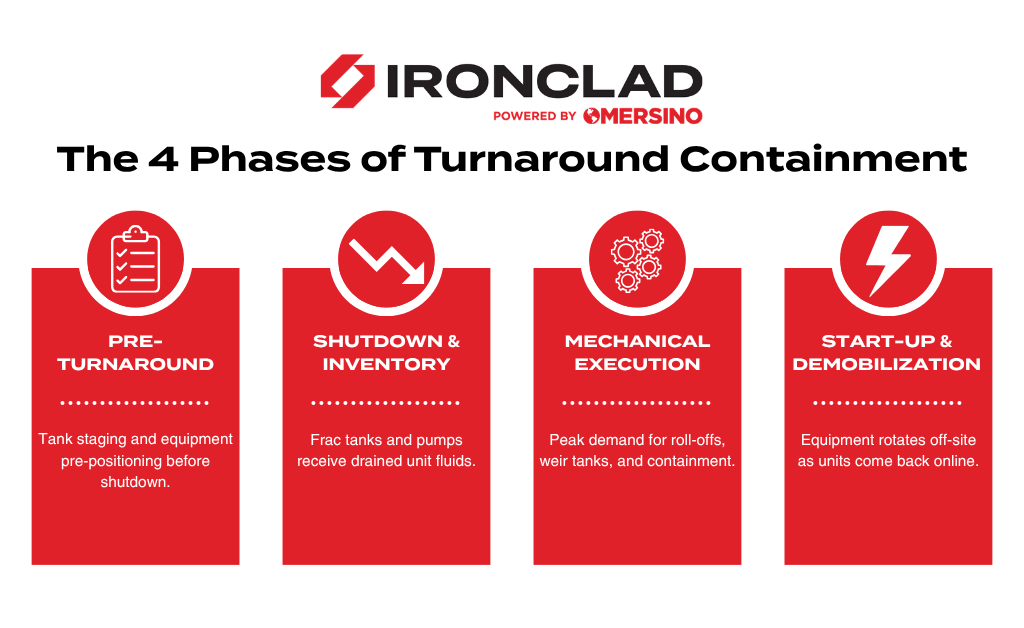
Matching the Right Equipment to Turnaround Phases
Containment maintenance needs aren't constant across a turnaround project. They shift as the work moves through its phases:
- Pre-turnaround: Site walk-down, equipment staging, and pre-positioning of tanks in locations approved under the contractor laydown plan.
- Shutdown and de-inventory: Peak demand for frac tanks, transfer pumps, and closed-top containment as process units come down and fluids move to temporary storage.
- Mechanical execution: Hydroblast returns, bundle cleaning containment, and ongoing wash-water management — this is where roll-offs, weir tanks, and secondary containment see the highest use.
- Start-up and demobilization: Equipment rotates off-site as units come back online, but slop oil recovery and final wash-water handling often extend past the nominal turnaround end date.
Right-sizing across these phases is where turnaround performance is won.
Facilities that treat containment as a single line item — one number, ordered once — almost always run into problems. An effective turnaround matches equipment to each phase of the turnaround process with swap-outs built in.
How Containment Integrates With the Turnaround Team
Containment equipment is one node in a logistics plan that also includes scaffolding, crane picks, contractor laydown, and unit-specific access. Placement has to be coordinated with all of it.
Refiners increasingly expect their containment partner to handle more than drop-and-go:
- Site surveys before mobilization
- On-site support during execution
- Responsive swap-outs when volume forecasts change mid-turnaround
Documentation matters just as much as the equipment itself. Tank certifications, inspection records, and waste transfer manifests are audit items that EHS teams need in hand — not promised after the fact.
EPA's RCRA hazardous waste generator requirements apply to many of the streams a turnaround generates, and post-event audits check whether documentation was maintained in real time.
Pulling tanks from one vendor, pumps from another, and roll-offs from a third multiplies the points of failure on a schedule that has no float.
Single-source containment coordination reduces the number of handoffs, compresses mobilization timelines, and gives turnaround planners a single accountable partner for the full waste stream. The significant impact on schedule reliability alone is often enough to justify consolidation.

IRONCLAD Powered by Mersino’s Turnaround Capabilities
IRONCLAD Powered by Mersino operates the largest specialty waste containment fleet in the United States, with coast-to-coast coverage that reaches major refinery corridors from the Gulf Coast to the East Coast and beyond.
That scale matters for turnaround planning. It means equipment depth is available whether a turnaround is scheduled eighteen months out or a mid-turnaround forecast requires an unplanned swap-out.
The full turnaround-relevant fleet includes:
- Frac tanks (open and closed top) for slop oil, wash water, and process fluid storage
- Specialty tanks including weir tanks for solids separation
- Roll-off boxes and vacuum boxes for sludge, catalyst, and solids handling
- Pump rentals for transfer and dewatering alongside containment
- Filtration equipment for discharge treatment and reuse
- Secondary containment and spill response support
With years of experience supporting refinery turnarounds and chemical plant shutdowns across the country, the Ironclad team understands a core truth: a crude unit turnaround doesn't look like a hydrotreater, and an FCC doesn't look like a reformer.
Each individual unit brings unique challenges that demand specific containment configurations and tools. Our experts work with turnaround planners from the pre-plan phase through demobilization — sizing fleets, coordinating swap-outs, and keeping documentation audit-ready.
Turnaround schedules don't flex. Fuel supply, production targets, and the bottom line all depend on units coming back online when the plan says they will.
Having a specialty containment partner with the right equipment, expertise, and commitment to safe operations locked in before the shutdown date is how high-performing plants protect uptime and deliver a successful turnaround event.
Planning a turnaround in the coming quarters? The earlier containment is locked in, the tighter the execution. Contact Ironclad Environmental Solutions to build a turnaround containment plan sized for your refinery units, waste streams, and schedule.