 Skip to content
Industrial Water Use Under Drought and Restrictions: The Capture, Store, Reuse Playbook

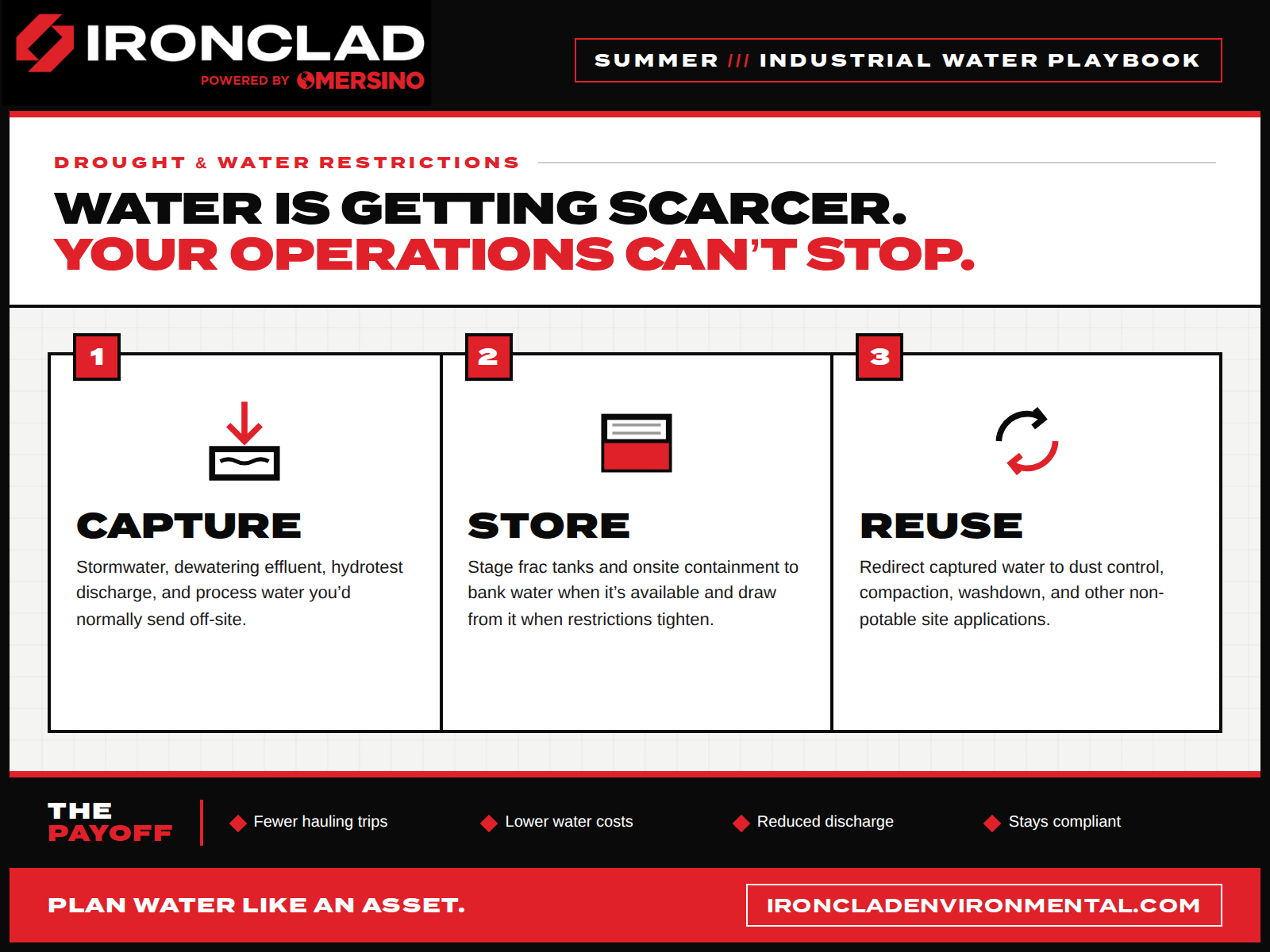
Drought conditions and summer water-use restrictions are reshaping how industrial sites source, use, and discharge water. Municipalities tighten the tap, hauled water gets more expensive, and the activities that depend on steady water access (dust control, hydrotesting, dewatering, process water) start to feel the squeeze first. For a growing share of the country, this is not a seasonal disruption. It is the new operating baseline.
The sites adapting fastest are the ones treating water as an onsite asset rather than a single-use input. Capture it, store it, treat it as needed, and put it back to work. IRONCLAD Powered by Mersino provides the containment and storage capacity that makes that shift practical at industrial scale.
Where Water Restrictions Hit Industrial Operations Hardest
When water gets scarce or expensive, certain activities feel it before others. The most exposed include:
- Dust control – on construction, mining, and pipeline sites
- Hydrotesting – for tanks, pipelines, and pressure vessels
- Construction and excavation dewatering – that still has to happen on schedule
- Process and cooling water sourcing – for ongoing operations
- Equipment and site washdown – for compliance and turnover
Each of these draws large volumes of water on tight timelines. When restrictions tighten or hauled water demand spikes regionally, the cost and availability problems hit immediately.
The Reuse Pivot: From Disposal to Onsite Water Asset
The traditional model treats most industrial water as single-use. Source it, use it, discharge it. Drought breaks that model in two places: sourcing gets harder, and discharge gets more scrutinized.
Capture and reuse flips the equation. Water that would normally be treated as waste, including dewatering effluent, hydrotest discharge, and captured stormwater, becomes an onsite resource. Stored in the right containment, it can be redirected to lower-grade uses like dust suppression, compaction, and washdown. The savings show up in three places at once: fewer hauling trips, lower water purchase costs, and reduced discharge volume.
The shift requires storage capacity and a plan for moving water around the site. Both are containment problems, and both are solvable with the right equipment staged in advance.
Dust Control: The Biggest Water User and the Easiest Reuse Win
On most active sites, dust control consumes more water than any other activity. Large open surfaces, repeat applications throughout the day, and high evaporation rates in summer all stack up. Suppression demand stays high even when restrictions are in place because the regulations driving it do not ease during a drought.
Operators still have to meet:
- Fugitive dust rules from state and local air districts
- PM10 limits for particulate emissions
- OSHA silica standards on construction and demolition sites
- Local nuisance ordinances near residential or commercial boundaries
The good news is that dust suppression does not require potable water. Non-potable sources work just as well for wetting active surfaces, which makes suppression the easiest reuse application to implement. Common feed sources include:
- Captured stormwater held in onsite tanks
- Dewatering effluent that has been settled or filtered to remove solids
- Treated process water redirected from other site operations
Staging frac tanks onsite gives operators a place to bank water when it is available, including during off-peak hours or after a rain event, and draw from it through the heat of the day when restrictions and demand are highest.
Hydrotesting and Dewatering Reuse
Hydrotesting and dewatering are two of the largest single-event water uses on industrial sites, and both are strong candidates for reuse.
Hydrotest water is typically clean at the start and only mildly affected by short contact with new pipe or tank interiors. With proper documentation and quality checks, the same volume can often be used across multiple tests or transferred to another project rather than discharged after a single use. Frac tanks provide the storage capacity to hold that water between tests.
Dewatering effluent from excavation, foundation, and trench work is usually higher in solids and sediment, but it does not need to leave the site. Captured into frac tanks, run through settling or filtration, and redirected to dust control, compaction, or washdown, it offsets a meaningful share of the water that would otherwise need to be sourced and hauled in.
In both cases, the equipment makes the strategy work. Vacuum boxes handle transfer and recovery. Roll-off boxes capture sediment. Frac tanks provide the storage volume that lets the site decouple water capture from water use.
Equipment for Onsite Water Capture, Storage, and Reuse
The reuse playbook depends on having the right assets staged before the season's restrictions take hold. The workhorses include:
- Frac tanks for large-volume water storage, staging, and transfer
- Roll-off boxes for capturing sediment, solids, and filter media
- Vacuum boxes for moving water and slurries between sources and storage
- Berms and liners for secondary containment around reuse storage and transfer points
For a full view of available assets and where they apply across industries, explore Ironclad's Solutions and Industry pages.
Compliance Considerations for Industrial Water Reuse
Water reuse is regulated, and the rules vary by state, locality, and end use. Before redirecting captured water to a new application, verify:
- State and local reuse rules for non-contact and dust suppression applications, which are typically the most permissive uses
- Discharge permit implications, including whether reduced discharge volumes change reporting or sampling requirements
- Water quality testing and documentation for the reused stream, especially when it has contacted contaminated soils or process residues
- Coordination with environmental consultants when projects cross jurisdictions or involve regulated contaminants
Most reuse for dust control and non-contact applications is well-supported by existing rules, but documentation is what keeps it defensible during an inspection or audit.

Plan Water Like an Asset, Not an Input
Drought conditions and summer water restrictions are not going away. For many regions, they are the operating baseline that schedules, budgets, and compliance plans now have to account for. Sites that build capture, storage, and reuse into their water plan protect three things at once: project schedule, operating budget, and regulatory standing.
Need help planning water storage and reuse capacity for your site? Ironclad's field experts can spec the right tanks, containment, and transfer equipment to keep your operation moving through the next round of restrictions. Contact Ironclad today to get started.