Skip to content
Case studies / Emergency response

Inside the data center response: How IRONCLAD Powered by Mersino supports hyperscale operators through cooling failures and capacity surges
The typical data center operator Ironclad works with runs a hyperscale or large enterprise facility, often part of a multi-site campus, somewhere between 100,000 and several million square feet. These facilities operate 24/7 under strict service level agreements with their end customers, and they depend on continuous cooling to keep server hardware within safe operating temperatures.
On the buyer side, the relationship typically lives with the maintenance manager. EHS gets involved on regulatory questions, particularly around containment and spill response, and procurement comes in on contract setup. The project manager role that drives most construction-side fluid management decisions is less central here, because data centers are operationally focused once the build is complete.
Geographically, the picture has shifted quickly. Data centers are still concentrated in long-established markets like Northern Virginia and Phoenix, but they are increasingly going up in regions that were not historically heavy on industrial fluid management infrastructure: Pennsylvania, New Jersey, suburban Texas, parts of Georgia. That shift puts pressure on regional providers and rewards operators with national fleet capacity.
The challenge
Two scenarios drive the majority of Ironclad’s data center work. They look very different on paper, but they share a common thread: when something goes wrong or capacity is needed fast, the cost of waiting is enormous.
Scenario A: cooling system failure
A cooling tower fails. A chilled water loop loses pressure. A heat exchanger goes offline during a planned upgrade and the upgrade runs longer than scheduled. Each of these scenarios sets the same clock running. The on-site team has minutes to hours before server temperatures begin to threaten hardware that can run a million dollars per unit, and that is before the downstream costs of customer dissatisfaction, regulatory exposure, and reputation damage start to accumulate.
In a failure scenario, the operator needs three things almost simultaneously: bridge water storage to keep the cooling system running while repairs are made, containment to prevent any released fluids from triggering regulatory action, and pumping capacity to move water between systems.
Scenario B: construction phase capacity
A new data center is going up. The site has different but equally specific demands:
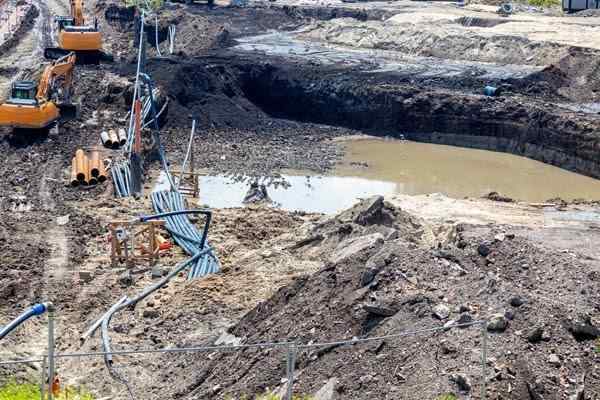
- Stormwater containment to keep runoff within regulatory limits during heavy rain events
- Dust control water from late spring through summer, when earthwork generates significant airborne particulate
- Hydrostatic testing capacity for new water mains, fire suppression loops, and cooling infrastructure
- Trade water for concrete pours and other large-volume needs during construction
Construction phase work tends to be more predictable than emergency response, but the volumes are larger, and a delay in any one of these areas can push the project schedule. Operators looking to bring a facility online by a specific date treat fluid management as a critical path consideration, not an afterthought.
The response
Ironclad’s response to data center operators is built around the pattern these facilities actually need: full equipment range, fast dispatch, and the option to pre-position the relationship before an emergency forces the issue.
For emergency cooling failures
When a failure call comes in, the response is immediate. The inbound call routes to the local sales rep, who gets operations involved on the spot, with no internal approval bottleneck slowing the response.
The equipment package depends on the failure, but typically includes:
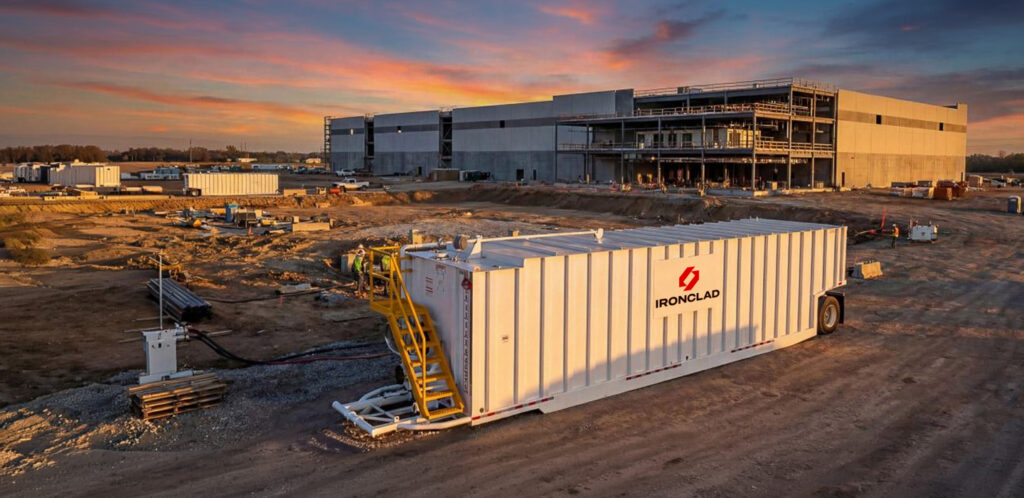
- Frac tanks for bridge water storage. Each standard frac tank holds roughly 21,000 gallons of capacity. For larger facilities or larger failures, IronMax tanks scale well beyond that footprint, supporting containment and storage at the volumes hyperscale operations actually require.
- Pumping capacity for system-to-system transfer. Tanks alone are not the answer in a cooling failure. Operators need water moved, often quickly, from storage into the cooling loop or between sub-systems.
- Roll-off boxes for waste handling. Any contaminated material or solid waste generated during repair has to leave the site, and a roll-off box on standby is part of a complete response.
- Containment liners and secondary containment. If anything releases during the repair, containment in place keeps the incident operational rather than regulatory.
The combination matters. A frac tank without a pump or a pump without a tank does not solve the problem. Ironclad’s full-service capability, including the recently expanded pump-side offering, lets operators handle the entire response through a single point of contact rather than coordinating across multiple vendors during a crisis.
For ongoing construction support
Construction phase work is largely about scheduling and scale. Ironclad supports new builds with:
- Scheduled tank deployments for stormwater management, sized to the site’s predicted runoff volume
- Recurring water deliveries via frac tanks paired with vacuum trucks for dust suppression
- Hydrostatic testing support, including storage, fill, pressurization, and water management during the test cycle
- Trade water access for concrete pours and other construction needs
The pre-positioned response option
For operators that want sub-four-hour response windows on emergencies, Ironclad participates in Oil Spill Response Organization (OSRO) frameworks and similar pre-negotiated agreements. The agreement is signed before anything happens. The response window is contractual. Equipment is ready to dispatch the moment a call comes in, not after terms are negotiated.
The outcome
Outcomes vary by engagement, but the patterns Ironclad sees consistently across data center work are clear:
- Response time: In active emergencies, equipment is typically dispatched within hours of the initial call. For OSRO-covered facilities, within the contractual window of four hours or less.
- Operational continuity: Facilities maintain cooling capacity during system repairs, avoiding the worst-case scenarios of full shutdowns and hardware damage.
- Regulatory protection: Containment in place during any fluid releases prevents EPA or state agency exposure, protecting both the facility’s operating permits and its corporate reputation.
- Account stability: Operators who go through one emergency response with Ironclad typically convert to standing relationships, often with pre-negotiated agreements covering future incidents.
- Cross-region support: Hyperscale operators with multiple facilities can work with Ironclad as a single account across regions, rather than managing relationships with multiple regional providers.
That last point matters more than it sounds. As data center operators expand into new geographies, the ability to bring an existing fluid management partner into a new region (without restarting procurement, without retraining a vendor on the operator’s protocols, without losing institutional knowledge) becomes a real operational advantage.
Why this pattern holds
Data centers are growing fast, and the fluid management infrastructure they depend on is not optional. Cooling failures and construction surges are predictable categories of need, even though the specific timing is not. The operators that come out best are the ones who establish the relationship before the emergency, not during it.
Ironclad’s combination of national fleet, full equipment range, and emergency response orientation matches the way data center operators actually buy. The maintenance manager calling at 2 a.m. is not running a procurement process. They are calling the partner they trust to show up. The piece of work that determines whether Ironclad is that partner happens months earlier, in the site walk, the OSRO discussion, or the first response that proved the relationship was real.
Working with Ironclad
Data center operators planning new builds, managing existing facilities, or building out emergency response plans can connect with the regional Ironclad team or reach out through ironcladenvironmental.com. For facilities that need sub-four-hour response windows, ask about setting up an OSRO or similar pre-positioned agreement. The relationship is most valuable when it is in place before it is needed.